
Purple Emperor Butterfly Profile
When it comes to hills and valleys, several countries make very grand statements: Canada has the Rockies, Peru has the Andes, and Switzerland has the Alps. Each is an area of outstanding natural beauty with its own outstanding natural fauna within.
Britain has some, too. The South Downs is England’s attempt at entering the third dimension: it’s a series of very pretty chalk lumps covered in grass; its highest peak towers a whopping 280 metres above sea level – almost enough to break an ankle!
But while it is a humble contribution in terms of altitude, it has some very special wildlife. And one of its prettiest residents is the Purple Emperor butterfly. A tenacious little insect with a big presence and some dirty habits.

Purple Emperor Butterfly Facts Overview
| Habitat: | Dense woodland |
| Location: | Widespread across Eurasia, North Africa |
| Lifespan: | Around 1 year to 18 months |
| Size: | Up to 9 cm across |
| Weight: | Unknown |
| Colour: | Males are black and purple with white marks, females similar patterned but browner |
| Diet: | Honeydew from aphids, juices from rotting flesh |
| Predators: | Birds, spiders, small mammals |
| Top Speed: | Slow |
| No. of Species: | 1 |
| Conservation Status: | Least Concern |
A butterfly this pretty can hide its secrets well. Being a woodland species, and one that spends most of its time in the canopy, the purple emperor gets away with some scary behaviours when it comes to feeding.
But it is also a mascot for British conservation, and its decline is tied to some very significant challenges on the ‘Isles. Thankfully for the species, it’s not confined to Britain, and is widespread in the Northern Hemisphere to the point that it’s not threatened at the species level at all.
Interesting Purple Emperor Butterfly Facts
[1] They’re Nymphalids
The order Lepidoptera contains all the butterflies and moths, and is one of those insect orders that’s just dizzyingly large. Much like bee experts, all but the most savant moth experts stop trying to remember most of them beyond the family level except where it’s necessary to focus on a particular study.
That’s because there are hundreds of thousands of species in this order, and so it’s no surprise that the family Nymphalidae, where we find the purple emperor, contains 6000 other species, too.
The Nymphalids are spread out all over the world, and are marked by some famous examples like the Monarch butterflies that go on those epic migrations, and the admirals, who flutter about in gardens in Europe and North Africa.
So, the purple emperor is in good company, and even follows the Imperial trend when it comes to its name. And, like the Monarch and the Admiral, it’s a woodland species.

[2] They’re widespread woodland butterflies
The South Downs isn’t known for its forest – this is typically a grassy hill part of the world, but there are oak outcrops, and the purple emperor isn’t endemic to the location, either. This is a butterfly that’s found all over the country and, indeed, much farther afield. It’s a member of the largest biogeographic realm on the planet: the Palearctic.
The Palearctic is pretty close to what is commonly described as Eurasia, but it also includes North Africa. It contains the Mediterranean, Norh Arabia, and East Asia, among other regions, and represents much of the Old World’s Northern Hemisphere (If you add the Americas to it, it becomes the Holarctic).
So, this species has a very wide range, and can be found in many of the patches of dense woodland across it. That means the species we see flitting about in the oak woodlands in Sussex in the UK is the same species that can be found in the Fungshui woodland of Western China.
In fact, nowadays, they’re not nearly as common in Britain as they once were.
[3] They’re elusive purple poop eaters
Sheb Wooley sung about a one-eyed, one-horned, flying purple people eater in 1958, and it remains unclear as to whether or not this was a misrepresentation of the little woodland butterfly that enjoys old oat outcrops in Sussex, but there are some similarities.
The emperor doesn’t have a horn, and has the usual two eyes (and at least two more ocelli on its wings), but it is purple, and it is flyin’. And while it doesn’t eat people – at least, not when anybody’s watching – it does eat poop.
This is a canopy species, and spends most of its time well out of reach of most lepidopterists and American novelty songwriters alike. As such, it’s pretty elusive, and its habits are not well documented, despite it being a very common and widespread species in Europe.
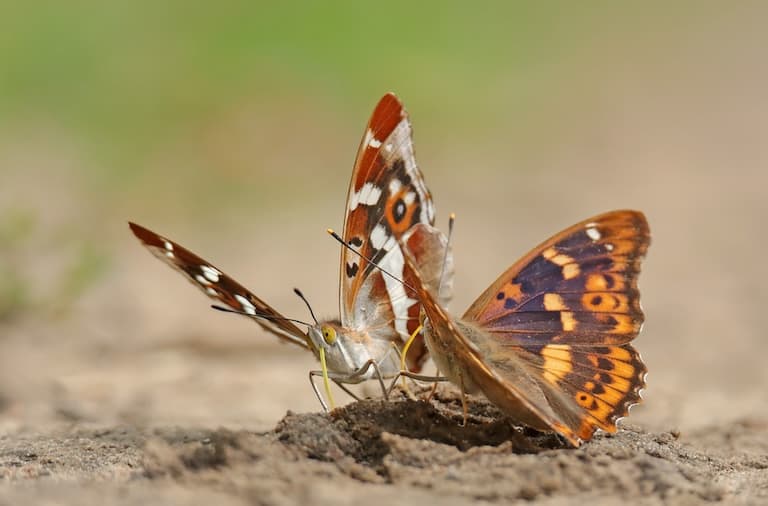
Females spend almost their entire lives in the canopy, and males come down, on occasion, to suckle from the moist wellspring of the fresh dung pile. This is more than just hydration – the purple emperor gets most of its nutrient requirement this way.
This is a very common sight on forest roads all over the world – butterflies get water and salt from a nice steaming pile of the morning’s deliveries, usually from large herbivores1.
[4] This can be used against them
So, this is a species that rejects the stereotype of nectar-feeding butterflies and relies almost entirely on butt soup and puddles to get its nutrients. They will also feed on honeydew from the backside of aphids, tree saps, and animal carcasses. The dietary habits of this pretty little butterfly are becoming morbidly fascinating!
In the 1920s it was recorded that to collect and pin this species, collectors would use decaying carcasses as bait to avoid the need for a 5-metre pole on the end of a butterfly net. Since then, they have been brought down from their ivory towers using even dirty nappies and blue cheese.
Critics of this luring method called it ‘unsportsmanlike’, which is a testament to how much more people cared about that sort of thing in the ‘20s2.
[5] They’re declining
Unfortunately, the increasing number of roads to support the increasing number of cars has had a powerful impact on this carrion-feeder. Roadkill lured in the butterflies, who then, too, become roadkill.
But roads do far more damage to wildlife than just hit them with vehicles.
Britain is still one of the most fragmented in the world when it comes to wooded habitat. It is improving; the land now boasts around 13% tree cover (up from 5% in 1900!), with the densest of that up in Scotland. But tree cover only tells a portion of the story.
With its natural forests decimated, the Isles’ recovery is limited. New growth forest is not as stable and rich as old growth, and much of it is harvested before it can become old. But perhaps most importantly, what’s there isn’t connected very well.
This species was considered very common in the south of England in the Victorian times, but by the ‘60s it was already scarce. In the UK, now, they’re not nearly as easy to spot3.
Fortunately, this is only one small fragment of their population.

[6] But they’re on the rise
This pretty little butterfly with some dirty habits, but this has carried it all across the Palaearctic realms, through much of Eurasia and North Africa, too.
So, while it’s struggling in Britain, the species as a whole is not threatened and is listed as of Least Concern to the IUCN, and is even on the rise.
And the good news is that this is precisely the sort of species that vindicated British ecologists. The re-wilding projects in the south of the country have seen a boost to their number, and since the species as a whole is doing well, it’s safe to experiment with new techniques in populations like this, to explore ways to make the countryside more accommodating to its native residents.
Purple Emperor Butterfly Fact-File Summary
Scientific Classification
| Kingdom | Animalia |
| Phylum | Arthropoda |
| Class | Insecta |
| Order | Lepidoptera |
| Family | Nymphalidae |
| Genus | Apatura |
| Species | iris |
Fact Sources & References
- “Purple Emperor”, Butterfly Conservation.
- Peter Eeles (2002), “Purple Emperor”, UK Butterflies.
- MacDowell (2025), “Rare butterfly hits purple patch at Sussex rewilding project”, The Guardian.